I grew up in the chemical industry before I ever worked in it.
My father had a PhD in chemistry, trained under Nobel Prize winner Alan MacDiarmid, and ran a chemical manufacturing company. Some of my earliest memories of his work aren’t about factories or labs. They’re about dinner.
“The customer wants better heat resistance but lower cost. Can’t be done with standard formulation.”
“Quality issue at the plant. The batch is off but within spec. Do we ship it?”
“Competitor is offering a similar product at 15% less. But their consistency is terrible.”
These weren’t hypothetical. They were that day’s problems. What I absorbed without realising it: chemistry is never just chemistry in business.
It’s chemistry plus customer requirements plus cost constraints plus regulatory compliance plus competitive positioning. All at once, all the time.
My father was the integration point. Every decision flowed through him because he could hold all those dimensions simultaneously. When he was available, decisions were fast and customers were happy. When he wasn’t, everything waited.
It wasn’t until years later, after completing my own PhD in chemistry and spending years building businesses in and around the chemical industry, that I realised something: every chemical company I encountered had the same pattern.
The names changed. The structure didn’t.
There was always someone like my father. Usually a handful of people. They carried the deepest knowledge about the products, the applications, the customers.
And they were simultaneously the company’s greatest asset and its most significant bottleneck.
What selling chemicals actually requires
If you sell software, your product does one thing and your job is to match it to someone who needs that thing.
If you sell chemicals, the product might do hundreds of things, and your job is to figure out which application, in which process, for which customer, under which conditions, your product is the right answer.
That’s not a sales problem. It’s a knowledge problem.
A customer doesn’t call and say, “I’d like to order 500 kilograms of your polyurethane dispersion.” They call and say, “We’re reformulating our adhesive for a flexible packaging line and we’re getting delamination at high speeds.” Or: “Can you recommend an alternative to a competitor product for automotive headrests?”
The rep who can connect that problem to the right product, the right formulation guidance, the right technical data, wins the business. The rep who has to say “let me get back to you” probably doesn’t.
This is what makes the chemical industry genuinely different from most other B2B sectors.
Commercial growth depends on the ability to link three things in real time: the product portfolio, the application landscape, and the customer’s specific problem.
Miss any one of those three and you either lose the opportunity or you never see it in the first place.
My father could hold all three in his head simultaneously. He could hear a problem and immediately triangulate across hundreds of products to find the right answer.
It took him decades to build that ability. And it couldn’t be copied, documented, or distributed.
Where the knowledge actually lives
In most chemical companies, expertise is distributed in a pattern that made perfect sense historically but creates serious constraints at scale.
The deepest knowledge sits with a small number of specialists. It was built over years, sometimes decades, through direct experience with customers, formulations, applications, and failures.
Much of it has never been written down.
The parts that have been documented exist across technical data sheets, application guides, internal reports, email threads, CRM notes, ERP records, and product information management systems that were never designed to talk to each other.
This isn’t a failure of planning. It’s just how knowledge accumulates in a technically complex industry.
When your portfolio has thousands of products, each with dozens of potential applications, each sensitive to process conditions and end-use requirements, there is no simple way to capture everything in a single system. So the knowledge stays distributed. In people, in documents, in institutional memory.
For a long time, this worked well enough.
Growth was steady, customer relationships were long, and the people who held the knowledge stayed around long enough to pass it on. My father’s company operated this way for years. Most chemical companies still do.
But the conditions that made that model sustainable are changing. And they’re changing faster than most people in the industry recognise.
The bottleneck
I recently watched a senior sales rep try to answer a straightforward customer question:
Can you recommend an alternative product for automotive headrests?
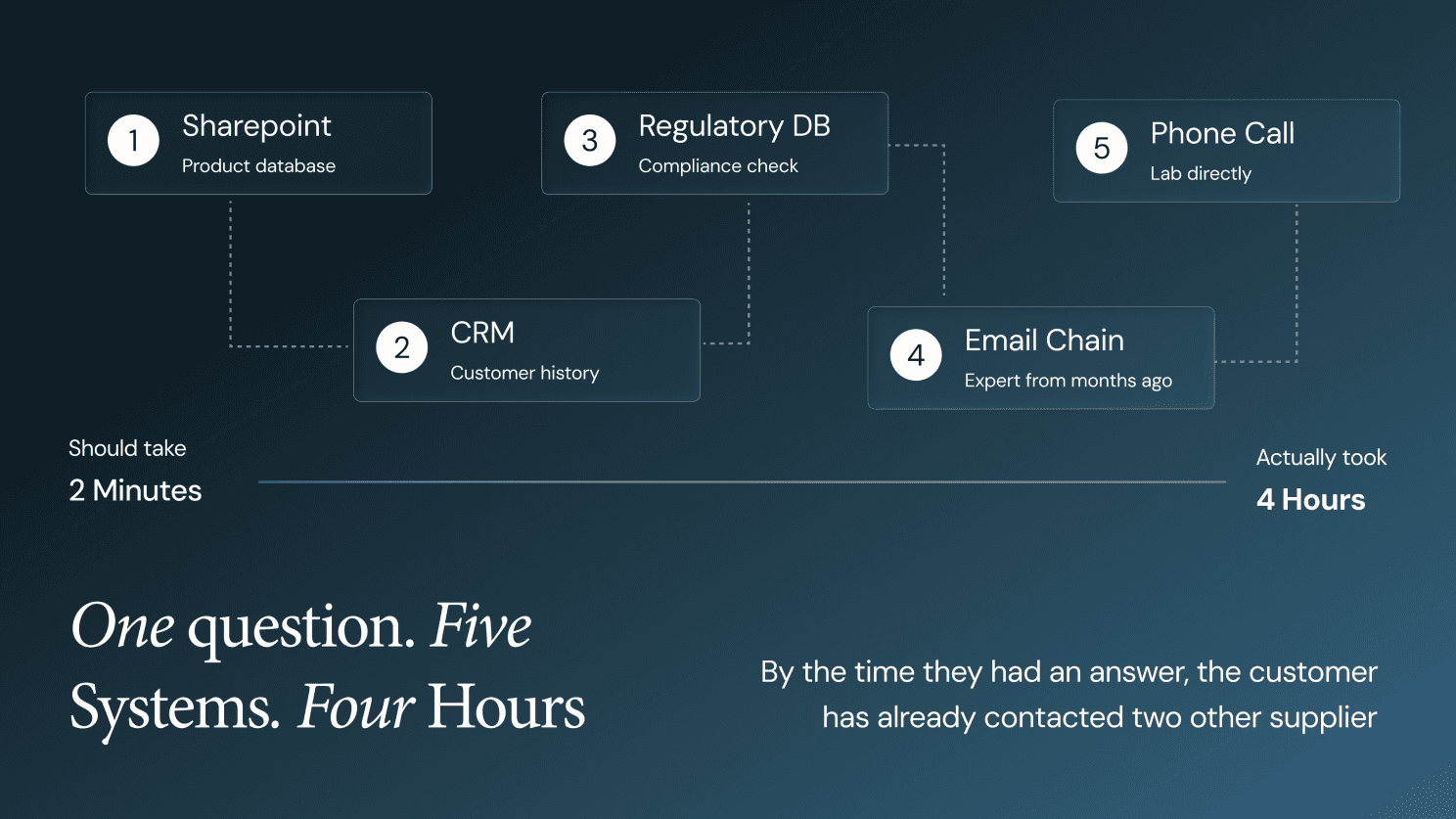
What should have taken two minutes took four hours.
Screen one: SharePoint, being used as a product database.
Screen two: CRM for customer purchase history.
Screen three: a regulatory database for automotive compliance.
Screen four: an email chain with a technical expert from months ago.
Screen five: a phone call to the lab directly.
By the time they had an answer, the customer had already contacted two other suppliers.
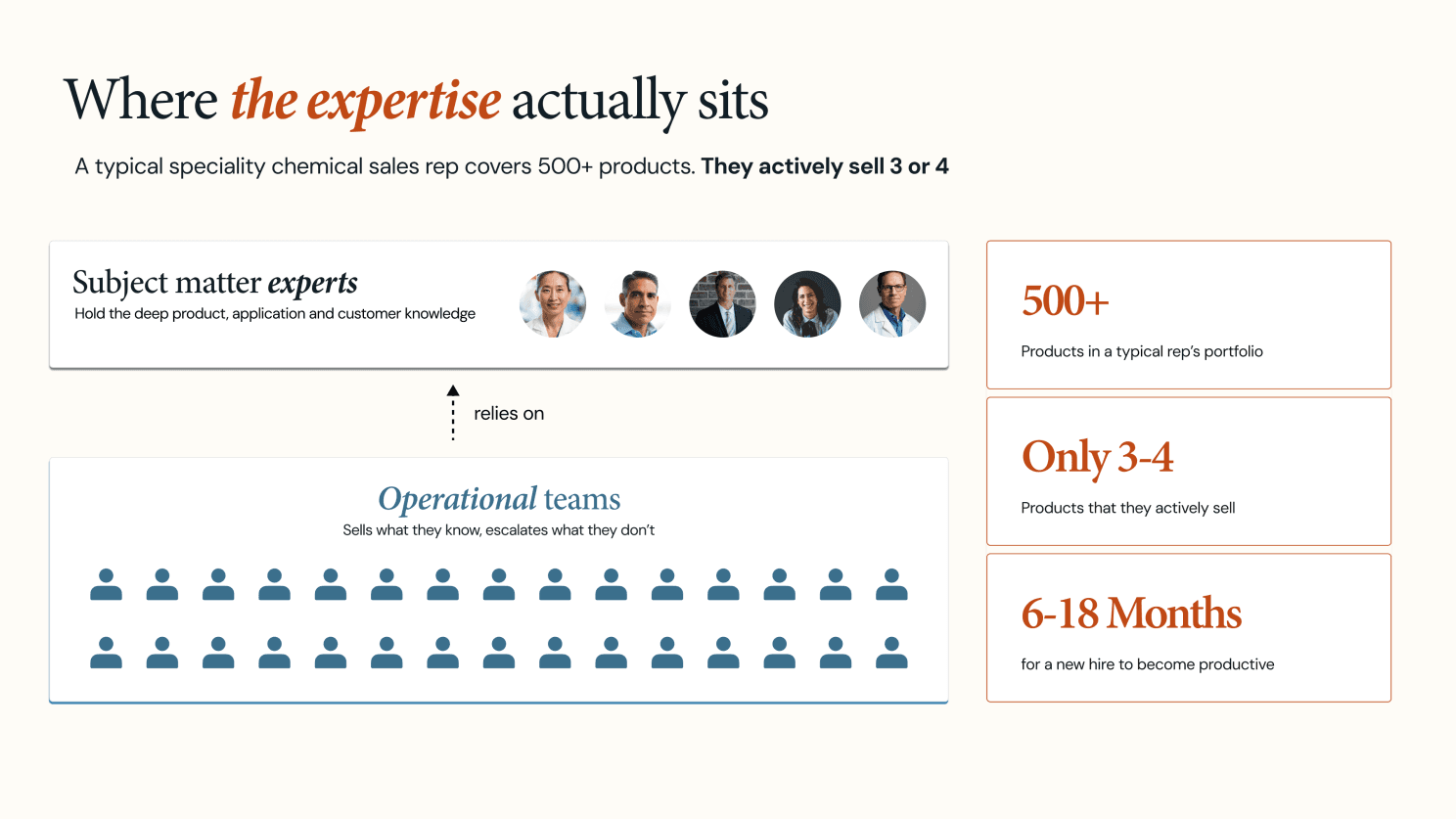
This isn’t unusual. A typical specialty chemicals sales rep might cover 500 or more products across dozens of application areas. No one person holds all that knowledge.
So what actually happens? Reps default to selling the three or four products they know well.
The rest of the portfolio, sometimes hundreds of products, sits underutilised. Not because the products aren’t good. Because the people selling them don’t have the expertise to match them to customer problems.
Meanwhile, the people who do hold that expertise are stretched to breaking point.
The specialty chemicals workforce has been ageing for years. Experienced application engineers and technical sales people who carry decades of product knowledge in their heads are retiring, and companies can’t replace them fast enough.
According to Accenture, around 30% of the chemical industry's workforce is over 50 and approaching retirement within the next decade. Meanwhile, engineering enrollment in key feeder markets has dropped by double digits.
This was a slow-burn problem for 15 years. It's now acute.
Customer expectations have shifted in the other direction. A distributor used to wait 48 hours for a recommendation.
Now, as one executive at a major chemical distributor told me recently: “Our customers research independently and contact multiple suppliers simultaneously. First accurate response wins.”
A Global Director at a construction materials company asked me why their sales cycles take eight months. The answer had nothing to do with the product, the price, or the competition.
It was the time between question and answer.
Each technical query triggered a relay: sales to technical team, technical to regulatory, regulatory to R&D, then back again. Each handoff added days. The product recommendation itself could have been determined in a day if the right expertise was accessible in one place.
None of this shows up in a single line item on a P&L. But when you add it up, the gap between what a chemical company could sell and what it actually sells is enormous.
Why existing systems haven’t fixed this
This is worth addressing directly, because it’s a source of genuine frustration across the industry.
Chemical companies have invested heavily in data infrastructure over the past decade. PIM systems, CRM platforms, ERP upgrades, document management tools. These investments weren’t wrong, but there's meaningful difference between storing information and making expertise usable.
As one food ingredients manufacturer put it to me: “The information exists, it’s just not user-friendly at all.”
A European distributor managing seven separate ERPs said it more bluntly: “To look up a product, you first need to know which system it’s in.”
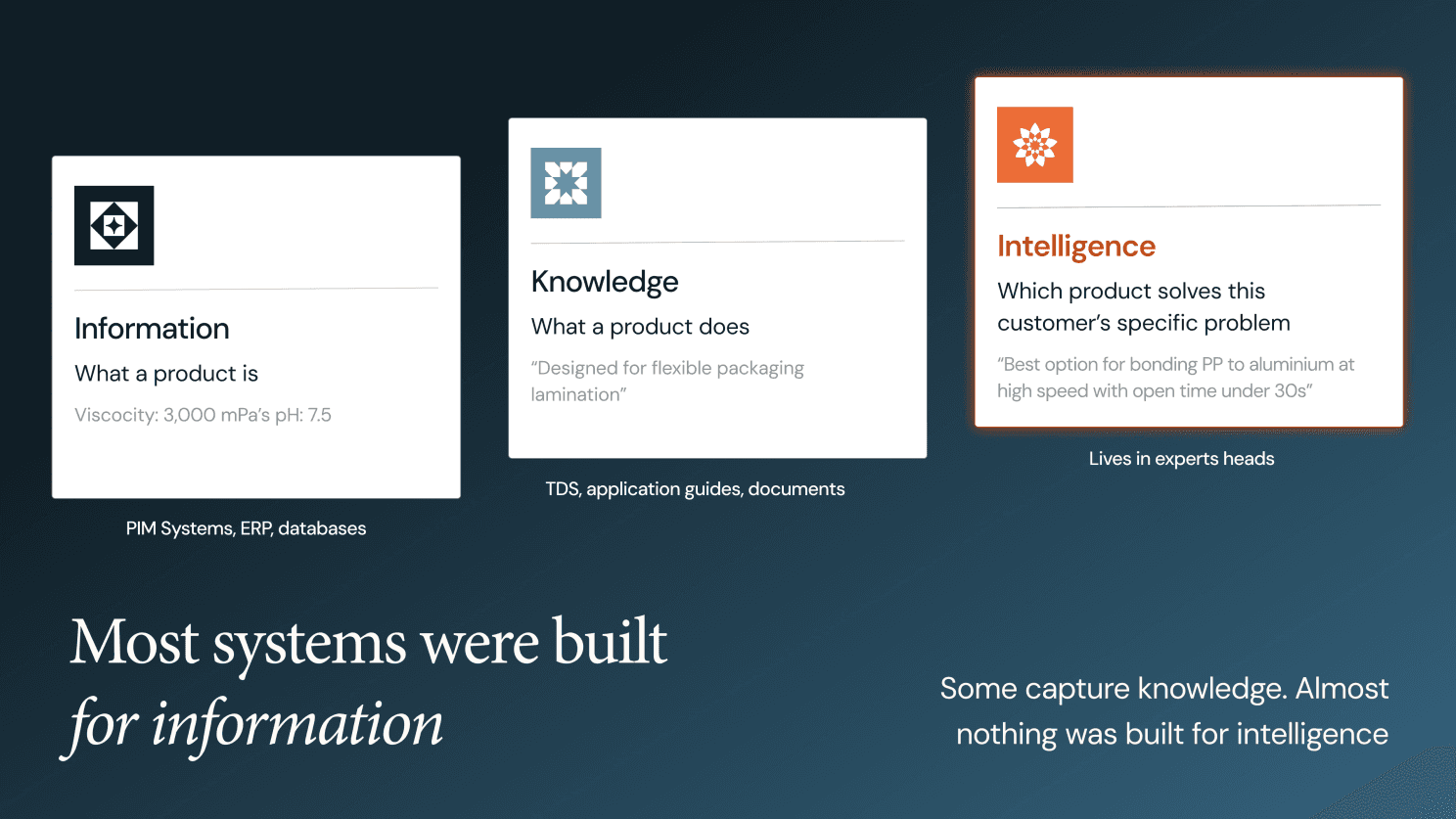
A PIM system can tell you that a product has a viscosity of 3,000 mPa·s and a pH of 7.5. That’s information.
A technical data sheet can tell you that the product is designed for flexible packaging lamination. That’s knowledge.
Neither can tell you that this product is the best option for a customer bonding polypropylene to aluminium in a high-speed process who needs open time under 30 seconds.
That’s intelligence: knowledge applied to a specific situation.
Most systems were built for information. Some capture knowledge. Almost nothing was built for intelligence.
And even when companies have tried newer technology, the results have been sobering.
A large European chemical distributor spent six figures building an AI chatbot for their sales team. They did it properly: enterprise platform, Azure infrastructure, 750,000 PDFs indexed and searchable.
The technology worked. Nobody used it.
They’re now on version two with a different vendor, still struggling.
The reason is instructive. They treated it as a search problem. Give the sales team a way to find information across documents faster.
But a sales rep doesn’t ask “find me the TDS for product X.” They ask “What should I recommend for a customer switching from a competitor product in an automotive interior application that needs to meet EU REACH?”
That’s not search. That’s not even a knowledge problem. It’s an intelligence problem. It requires the kind of applied, contextual reasoning my father had: built through thousands of customer conversations, hundreds of failed experiments, and a deep intuition for how chemistry behaves in the real world.
So humans remain the integration layer. They translate between systems, connect dots, apply judgment the software can’t.
And humans don’t scale.
What the companies that solve this will look like
I believe the chemical companies that find a way to make their expertise consistently accessible to their commercial teams will grow in a fundamentally different way.
Not because they’ll have better products.
Not because they’ll have better salespeople.
But because they’ll be able to deploy their full knowledge, across their full portfolio, to every customer interaction.
Think about what that actually means.
A new sales rep answering the same technical question that today only a 20-year veteran can handle.
A distributor getting a qualified product recommendation in minutes rather than days.
A customer searching for a solution on a manufacturer’s website and getting real technical guidance, not a product catalogue and a “contact us” form.
Institutional knowledge built over decades that doesn’t walk out the door when someone retires, but remains available to every team, in every region, at every level.
That company doesn’t just sell more. It sells differently.
It responds faster, qualifies better, covers more of its portfolio, and earns a kind of trust with customers that becomes very difficult to compete against.
The question isn’t whether chemical companies have enough data or enough tools. They do.
The question is whether the expertise that makes their products valuable can be scaled beyond the small number of people who currently hold it.
My father built his expertise over a lifetime. It made him indispensable. It also meant that the company’s growth was tethered to his availability, his energy, his memory.
The chemical industry has never had a shortage of knowledge. It has a distribution problem.
The expertise exists. It’s just trapped.
The companies that figure out how to free it will be the ones that grow differently over the next decade.
Not because they changed what they sell, but because they finally closed the gap between what they know and what their customers experience.