The Chemical Industry Digitised Its Products. It Hasn't Digitised the Conversation.
Your buyers are asking ChatGPT, not you.
A few months ago I sat down with the marketing leader of a specialty chemical company to go through her website analytics. Traffic looked healthy: thousands of visitors a month, time on site that suggested people were actually reading. Then we looked at the contact form. Maybe thirty submissions in a good month, out of thousands of visitors. She pulled up the submissions themselves: a name, an email, a company, a product name that was sometimes the wrong one, and occasionally a note in the free-text field: "Interested in learning more."
That was the entire output of a website that cost six figures to build and receives more traffic than most trade show booths see in a year.
She couldn't name what was wrong precisely, but she described it in a way I've now heard from dozens of commercial leaders: "I know people are coming to our site with real questions. I just don't think our site is answering them."
Then she showed me where those questions were actually going. She opened ChatGPT and typed in a technical question about one of her company's flagship products. The answer referenced her company by name. Some of it was accurate. Some of it wasn't.
Either way, no lead was generated, no conversation was started, and her sales team would never know it happened. That was what unsettled her most: her website wasn't answering buyer questions, and other platforms were answering them instead, sometimes well, sometimes badly, always without her narrative being dominant.
Product information has become more accessible than it has ever been. The conversation around it has not. That gap is now the most expensive thing on a chemical industry website, and almost nobody is measuring it.
"Product information has become more accessible than it has ever been. The conversation around it has not. That gap is now the most expensive thing on a chemical industry website, and almost nobody is measuring it."
Your product finder is solving a problem your buyers don't have.
To see why, follow a real buyer through the experience as it exists today. Not a casual browser. Sara, a formulation chemist at a packaging company, needs to reformulate an adhesive for a flexible packaging line. She's getting delamination at high speeds and needs a product with the right open time and bond strength on polypropylene. She knows the chemistry well enough to describe the problem precisely. What she doesn't know is which product in this particular supplier's portfolio is the right fit. She goes to their website.
The product finder offers dropdowns: product type, chemical family, application segment. She selects "adhesives." The results return twenty-three products, listed by product code, each with an attribute table showing viscosity, solids content, glass transition temperature.
The information is accurate. For what she actually needs, it's almost useless. She doesn't need to know the Tg of every adhesive in the range. She needs to know which one will solve a delamination problem on polypropylene at high line speeds. That question lives at the intersection of application knowledge, process conditions, and product performance, a place where attribute tables don't reach.
She tries the search bar. The first thing she types is what she would say to a technical sales rep if one were on the phone:
"Need a hot-melt adhesive for bonding polypropylene film at line speeds above 200 m/min. Currently using a competitor product that delaminates at speed. Open time under 2 seconds. Food contact, EU regulated."
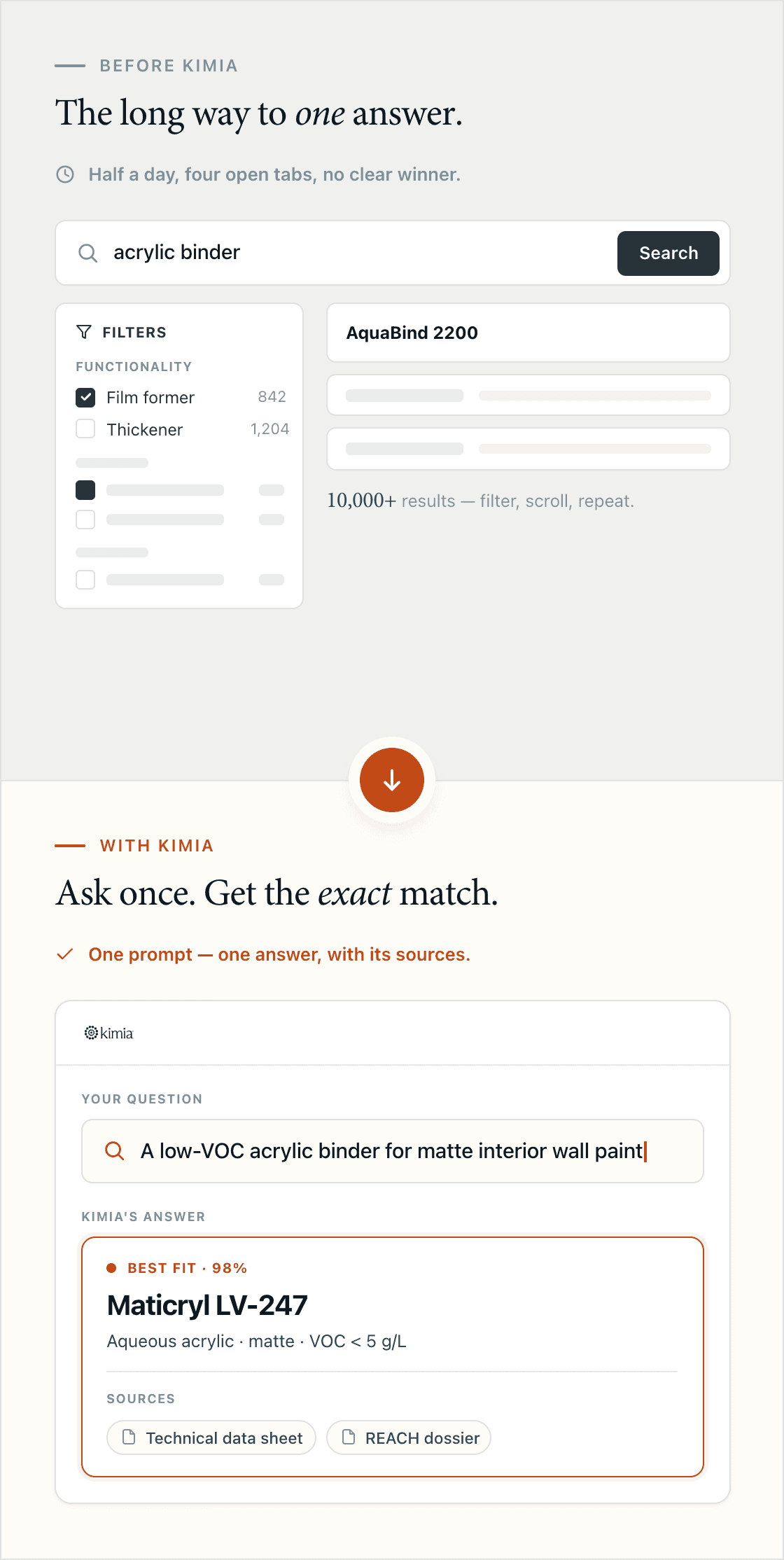
That is not a search query. It is a question. It is the opening of a conversation, compressed into the only input field on the page. The search bar cannot answer it. The product finder cannot answer it. No combination of dropdown filters can. None of those tools were built for semantics, chemistry, or scientific reasoning. They were built to traverse attributes.
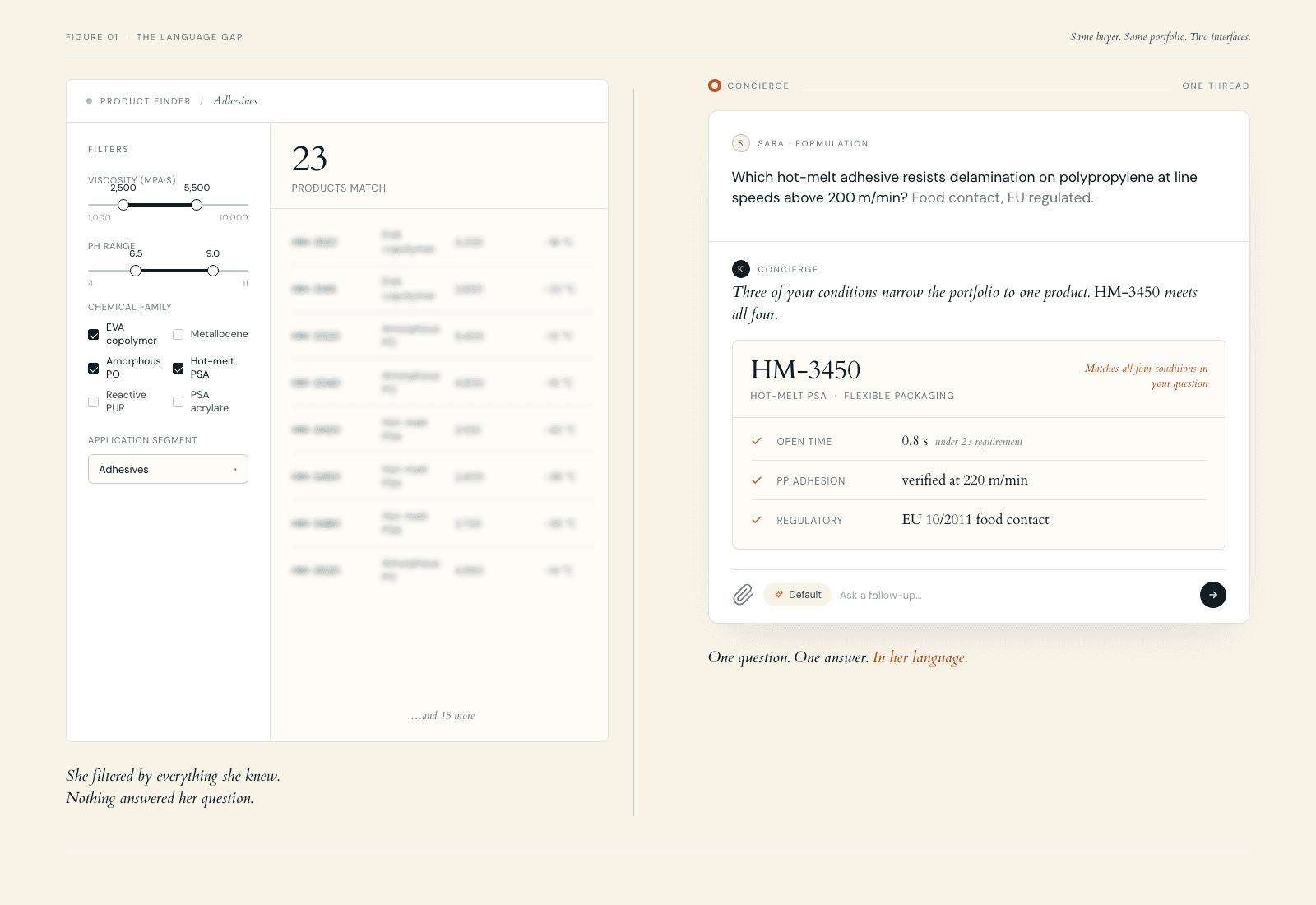
What she gets back is a list of PDF technical data sheets, ranked by keyword relevance. She opens three, scans for application guidance, and finds general statements: "suitable for flexible packaging applications." That describes half the range.
She could fill out the contact form. But she's comparing three suppliers simultaneously, and the one that gives her a useful answer first will get the sample request. She doesn't have time to submit a form and wait two days for a sales rep to call her back, especially when that rep will probably ask her the same questions she just tried to answer on the website.
So she leaves.
What just happened isn't a failure of the marketing team or the web development agency that built the site. It's a structural consequence of how product information has been organised in this industry for decades.
Products are catalogued by what they are: chemical composition, physical properties, product family. Buyers search by what they need to do: solve an application problem under specific conditions.
Buying chemical products is problem solving. You don't solve a problem by browsing options. You can buy sneakers that way. Not chemicals. That's a language gap, and no amount of PIM investment or website redesign has closed it. The gap is about applied intelligence, not data quality.
The same gap exists inside the building. The product data is there; the intelligence to connect it to a specific problem isn't, which is why a senior technical expert still has to accompany most complex sales conversations. The website is simply where the gap is most exposed, because there's no senior expert standing behind it.
A veteran sales rep could hear that buyer's question and, within minutes, narrow the portfolio to two or three candidates, explain the trade-offs, and recommend the one most likely to work. The website can't do that. It was never designed to.
The opportunities you're losing aren't in your pipeline.
What that gap costs in commercial terms is significant, but almost entirely invisible. It doesn't appear as a line item. It shows up in three patterns that most companies sense but rarely measure.
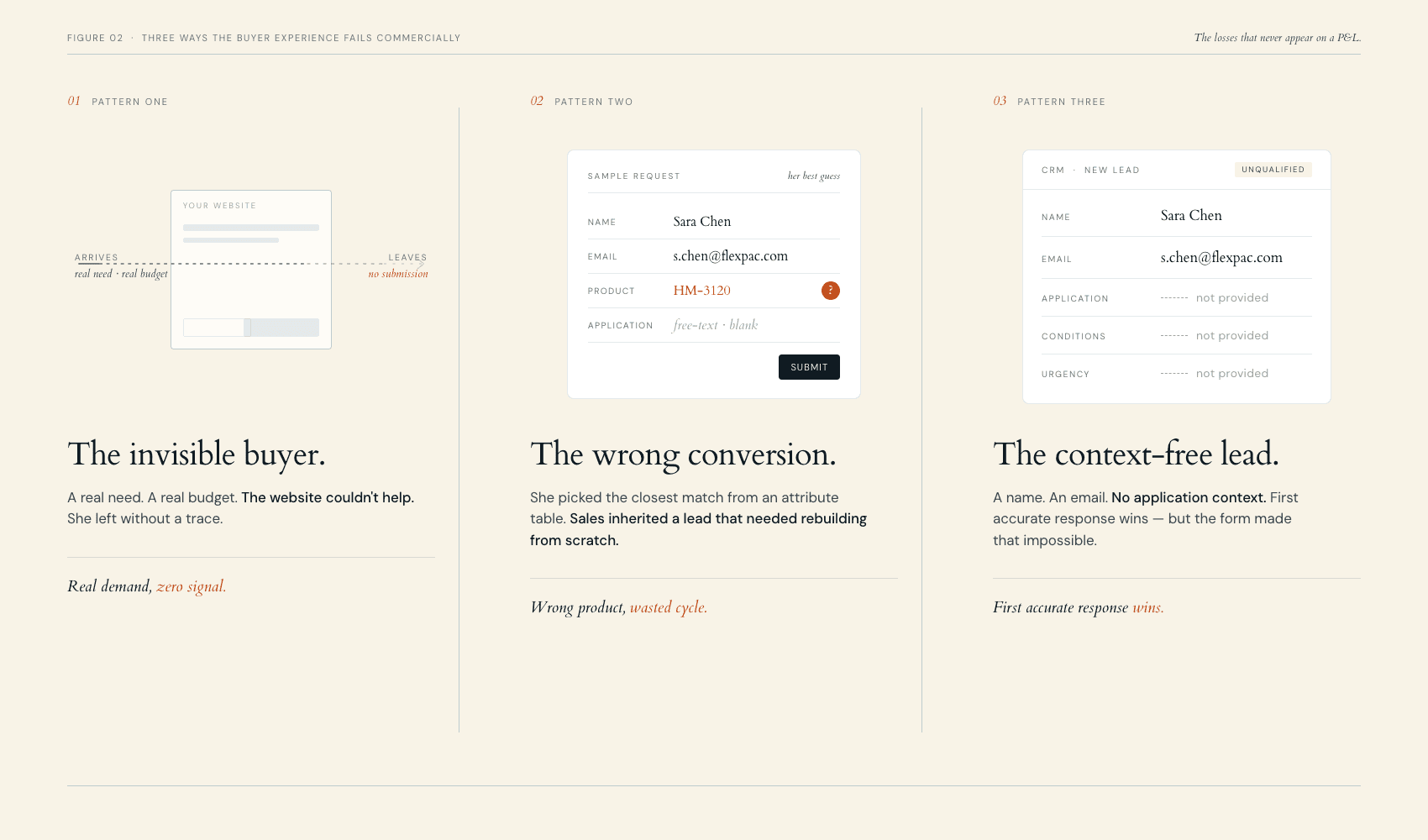
The first, and most consequential, is the buyer who leaves without a trace. She arrives with a real need, a real budget, and a real timeline. The website can't help her. She doesn't fill out the contact form because the form asks for information she doesn't have yet: which product she wants. So she leaves. No submission, no sample request, no record she was ever there. The contact form conversion rate measures the people who persisted through a broken experience. It says nothing about the people who came closest to buying and then went to a competitor instead.
The second pattern is more insidious: the wrong conversion. A buyer does engage. She navigates the product finder, makes her best guess from the attribute tables, and submits a request for a product that seems close to what she needs. She's chosen the closest-looking option based on data that was never designed to answer her question. Sales inherits a lead that looks like progress. Two weeks and three rounds of technical clarification later, it turns out the buyer actually needs something entirely different. The cost is invisible on a P&L but real in sales team time and cycle length.
The third is the context-free lead. A buyer submits a sample request, and what arrives in the CRM is a name, an email address, and a product name. No application context. No process conditions. No sense of how urgent the need is or how far along the buyer is in her evaluation. The sales team has to start qualification from scratch. As one commercial leader at a major distributor told me: "First accurate response wins." The problem is that the contact form, as designed, makes an accurate first response structurally impossible. The rep calls back, asks the questions the website should have asked, loops in a technical specialist, and gets back to the buyer days later. By then, the supplier who could answer faster has already sent a sample.
"First accurate response wins."
This is not a chatbot problem.
This isn't for lack of trying. Chemical companies have invested heavily in data infrastructure over the past decade: PIM systems, CRM platforms, ERP upgrades, product finder tools. These investments weren't wrong. But there's a meaningful difference between organising information and making expertise accessible.
Product finders improved the navigation of attributes, letting buyers filter by chemistry, by application segment, by physical property. That was a real step forward from browsing a PDF catalogue, but it didn't change the language of discovery. The gap between attribute language ("viscosity: 3,000 mPa·s, pH: 7.5") and application language ("which of your dispersions gives me the best open time on polypropylene at high line speeds?") remained exactly as wide as before.
Others tried to solve it with decision trees: structured question flows designed to guide a buyer from a broad need to a specific product. The marketing lead at a top-ten specialty chemical company told me they spent two years on exactly this approach, with tens of their application engineers working to codify their knowledge into decision paths. Two years, and they still couldn't get it to work. The problem wasn't willpower or resources; it was that expert knowledge doesn't follow decision trees.
The next assumption was that the problem could be solved by aggregating documents and putting an AI layer on top. Gather every TDS, SDS, application note, formulation guide, and regulatory document into one searchable system. Make it conversational. Done. It is a reasonable-sounding assumption, and it is wrong. Retrieval gives a system access to information, not judgment. It can't tell you which facts are binding, which sources to trust when they conflict, or whether the evidence is strong enough to support a recommendation at all. A buyer's question about whether a product is the right fit is a reasoning problem, not a search problem. It's constrained by application physics, regulatory boundaries, and the realities of a portfolio that shifts over time.
Our CTO has written about what this requires technically, in the context of AI for internal technical sales teams. The surface differs by deployment, but the atomic unit underneath is the same: chemical intelligence. The technical, regulatory, and application knowledge that makes any answer in this domain trustworthy. Without it, what you have isn't a technical advisor. It's a chatbot dressed up in your branding, confidently producing answers it has no basis to trust. The foundation model is the easy part. The hard part is the chemical intelligence layer, the source governance, the business rules, and the workflow around it.
"The foundation model is the easy part. The hard part is the chemical intelligence layer, the source governance, the business rules, and the workflow around it."
That underestimation is everywhere. I had a meeting recently with the CMO of one of the world's largest chemical companies. He told me they had spent the better part of two years trying to build something like this internally. They had the resources. They had the engineering talent. They had access to the same foundation models everyone else does. It still didn't work. He described coming across our work with one of our customers, stress-testing it over and over, and bringing it back to his senior team. The question he asked was straightforward: how soon could we deploy one for them.
Bostik themselves came to us asking for a chatbot. We pushed back. What they actually needed was a technical advisor that understood their portfolio, their application segments, and the questions their buyers were actually asking, not a chatbot layered over a product catalogue. They kept calling it a chatbot. The label didn't matter. What mattered was that a generic conversational interface, built for consumer contexts and stretched to fit a technical product line, couldn't hold the domain knowledge that makes the answer trustworthy in the first place. The system that's now live on Born2Bond looks nothing like what they originally described.
The failure wasn't the technology. It was applying the wrong kind of technology to the wrong kind of problem.
The shift isn't the AI. It's the chemical intelligence underneath it.
What has actually changed, and what makes this moment different from every previous attempt, is the ability to build AI that operates with chemical intelligence. That intelligence has multiple layers: the technical, regulatory, and application knowledge that makes any answer in this domain trustworthy, plus the company's own business logic, supply chain reality, and the ability to adapt to how individual buyers behave. It can hear a question framed in the language of an application problem, not the language of a product catalogue, and connect it to the right product in a portfolio of thousands. It can understand that "delamination at high line speeds on polypropylene" is really a question about open time, adhesion to low-surface-energy substrates, and heat resistance under converting conditions, and navigate the portfolio with that understanding. That is the difference between organising information and applying intelligence.
In the companies that have moved on this, three things start happening.
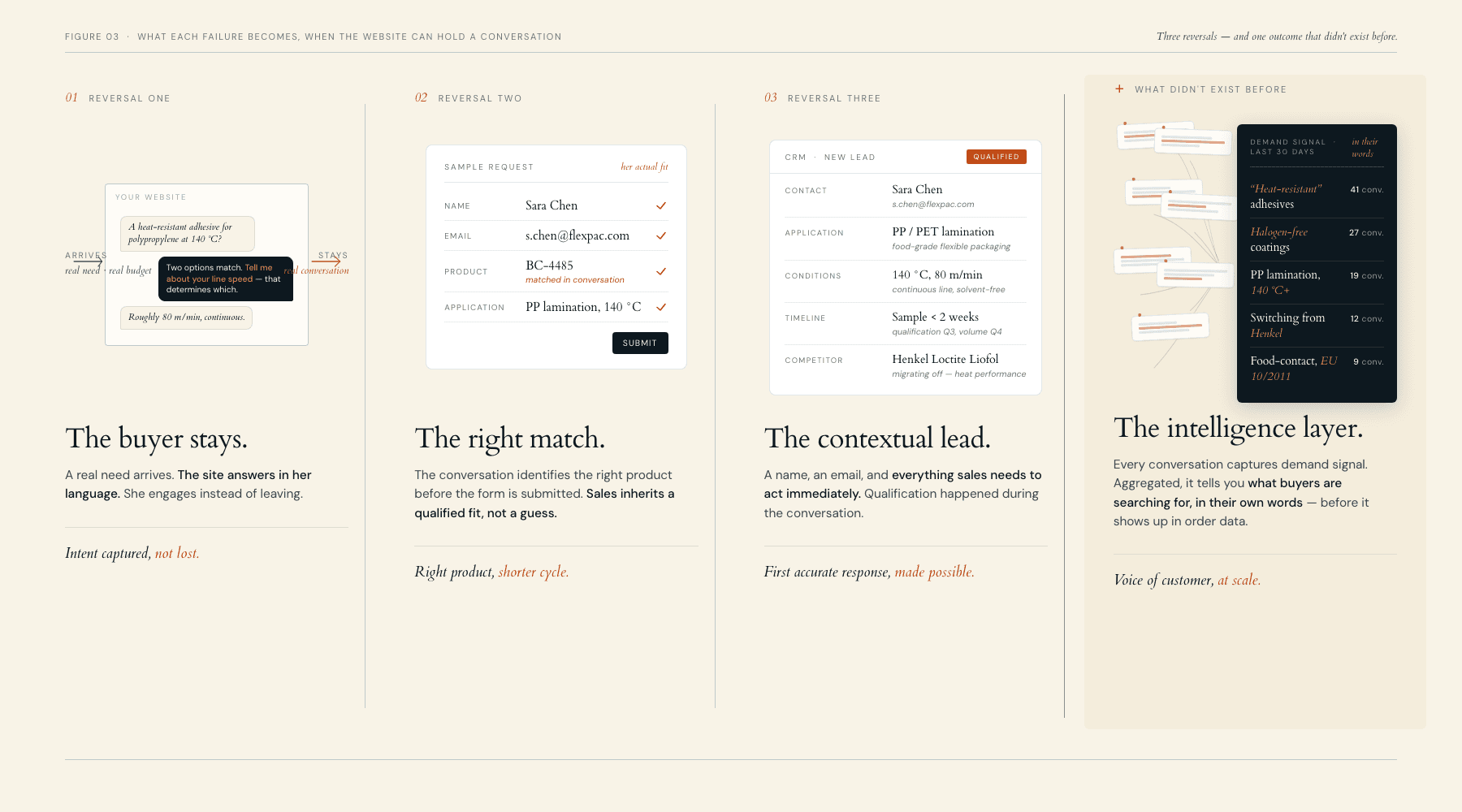
The invisible buyer becomes visible.
Firstly, when a website can hold an expert conversation, buyers start engaging with it. Not because a more aggressive popup caught them, but because something on the page was actually useful at the moment they had a question. What you start capturing is buyer intent in its raw form: the application they're working on, the constraints they're under, the alternatives they're evaluating.
Bostik now sees over a thousand buyer conversations every week through their Concierge, an order of magnitude more engagement than any contact form was ever going to produce. Sample requests increased by a factor of six. Not because more people were visiting. Because more of the people who were already visiting found a reason to stay.
Your sales rep know more about the buyer
Once intent is being captured, what arrives in the CRM changes. The sales team no longer receives a name and an email; they receive an application need, a product match, a set of process conditions, and a clear signal of how serious the buyer is. Qualification doesn't start from scratch. It starts from context.
One adhesives company I work with described a technical problem that previously would have taken their team two or more days to diagnose and respond to. With the right expertise made accessible on the website, a comparable question was resolved in thirty minutes.
The product was the same. The knowledge was the same. What changed was the speed at which it could be applied, and that speed opened up follow-on opportunities with the same customer that would not have surfaced otherwise.
And the shift goes deeper than faster CRM data: in most chemical companies today, lead qualification is manual triage that happens after the buyer has already left the website, and a significant portion of leads turn out to be poor fits the sales team only discovers days into follow-up. When intelligence runs during the conversation rather than after it, the system can match application requirements to the portfolio in real time, identify when a need falls outside it, and flag genuine commercial opportunity at the point of engagement.
What arrives in the CRM is no longer just a lead with context, but a lead that has already been assessed for fit.
Your marketing team knows more about the buyer
The third, and the one I think will prove most significant over time, is the intelligence layer that emerges from these conversations. Every interaction captures something: the application a buyer is working on, the performance gap they're trying to close, the competitor product they're trying to replace, the regulatory constraint they're navigating.
Individually, each conversation is a lead. Aggregated across hundreds, it's voice of customer at a scale and specificity no survey or sales debrief can produce.
Marketing teams can see, for the first time, what buyers are actually searching for, in their own language. They can see where the portfolio has gaps, which competitor products keep appearing as replacement targets, and which regulatory topics are trending before they show up in order data.
This is market demand signal that currently bounces without a trace, and when it's captured it has value well beyond sales: product development, R&D prioritisation, portfolio strategy, all grounded in what real buyers are actually asking for in their own words.
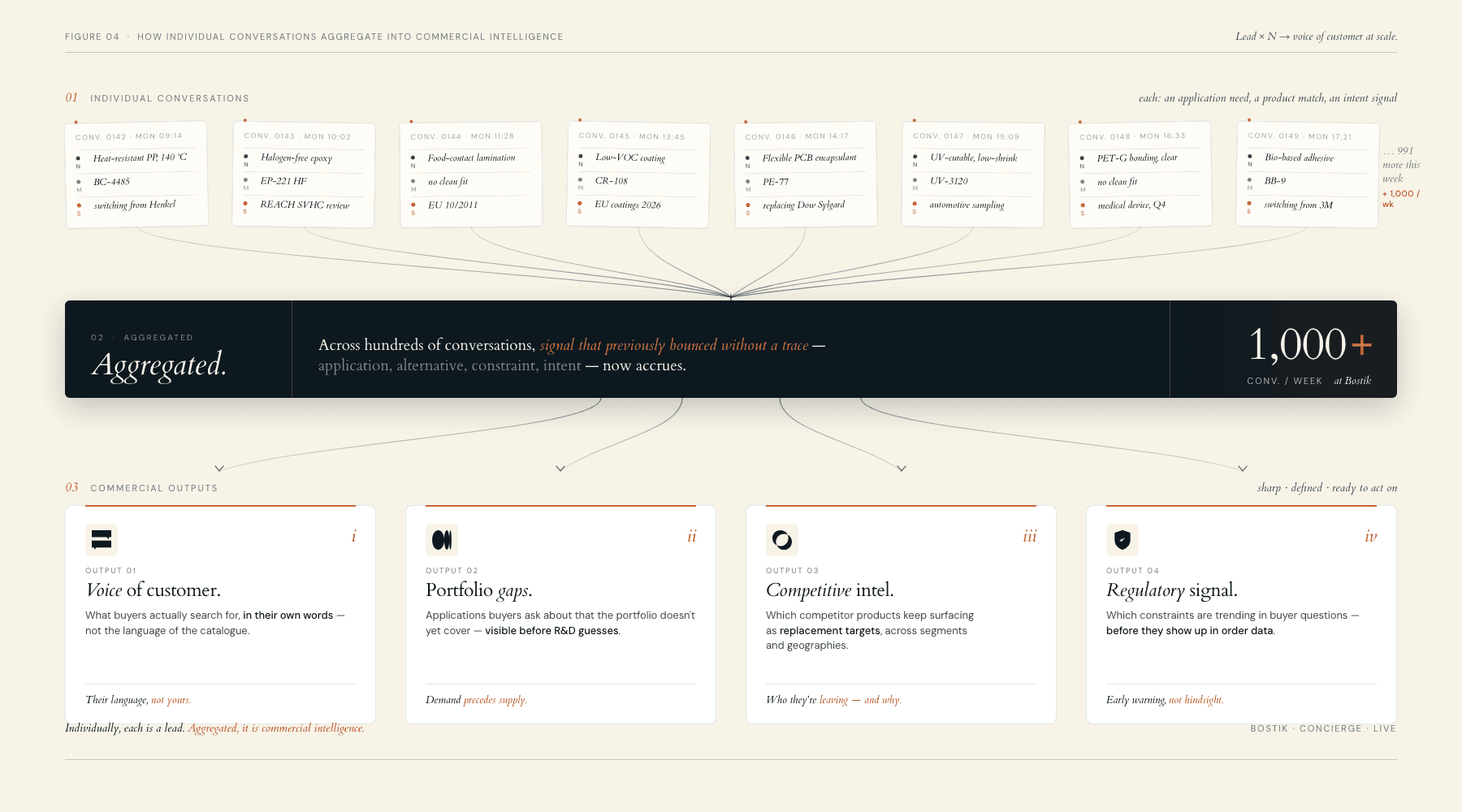
None of this is possible with a product finder built on attribute matching and keyword search. It requires context matching: understanding what someone means, not just what they typed.
A new commercial channel, not a better website.
What we've been describing is bigger than better website software.
AI has transformed how individuals function over the last few years. Everyone feels more productive, more capable, more equipped to do the work in front of them. Nobody wants to go back to how things were done in 2022. The open question for teams and leaders is what this technology does to a function, not just to the people inside it.
For chemical sales, the answer is that it creates a new commercial channel. One that captures buyer intent the moment it arrives, that scales beyond the limits of human hours and human expertise, that runs continuously, and that feeds back into the rest of the commercial organisation: marketing, product development, R&D, portfolio strategy. That's a different conversation than "we added AI to our website." It's a conversation about what a chemical sales function looks like when its first point of contact is an institutional intelligence layer, not a contact form.
The industry has always had technically sophisticated buyers and technically sophisticated sellers. The gap that has persisted is in how the two meet, and for decades the website sat in the middle of that gap doing very little to close it. That constraint has lifted. What's possible now is a website that functions as the first expert a buyer talks to: one that understands their application, knows the portfolio, reasons through trade-offs, and turns a conversation into something a sales team can act on immediately.
This is the problem we built Customer Concierge to solve. The companies that build this layer first will be the ones defining how buyers and sellers meet in this industry for the next decade. Chemical companies are going to look very different five years from now, and what's on the website will be a significant part of why. If you want to see what that looks like on your products, we should talk. Book a demo at kimia.ai