

Uwe Siebgens
Global Group Director
1 weekFor a new salesperson to be field-ready, down from months of training
30,000Data points added by hand by Stahl’s own experts, across roughly 1,000 products
1 clickFor a technical data sheet, compliant and in the customer’s language
Too much know-how to hand over in person
For most of Stahl’s history, an expert’s knowledge had a succession plan built into it. When a specialist neared retirement, their successor was hired half a year early and the two worked side by side until everything worth knowing had changed hands. Cost pressure killed that arrangement across the industry. A retiring expert is now often gone before their replacement arrives, and in some markets the gap between resignation and departure is measured in weeks.
That matters more at Stahl than it would at most manufacturers, because the products are downstream of the real asset. Stahl makes speciality coatings for flexible materials and sells them around the world through 1,800 people, but what it actually trades on is know-how: which chemistry, in which formulation, applied to which material, under which conditions. It took decades to accumulate, it is far too complex to simply write down, and it is worth nothing to Stahl the moment it leaks or leaves.
“I would not describe Stahl as a chemical company. I would describe Stahl as a know-how company.”
Paolo Bavaj, Chief Innovation and Corporate Development Officer
When Stahl started looking for an answer, it already knew what was coming. Several people with thirty-five and forty years of experience were approaching retirement, and much of their expertise was documented across different systems and teams, but Stahl wanted to make that knowledge easier to access, connect and scale globally.
Scattered across SharePoint, laptops and people’s heads
What had been written down was spread across whatever system happened to hold it. Some of it sat on SharePoint, some on individual laptops, and a good part of it, as Uwe Siebgens, who runs Stahl’s biggest business unit, puts it, “simply lived in the brains of the people.” Stahl had also grown by acquisition, so sites in different countries did the same work in different ways, and nobody could reliably know the latest product in another region.

The cost of that was not abstract. Laboratories ran customer work on products already scheduled to be phased out, because nothing existed to tell them otherwise. Segment managers defined the product ranges in one place while the sales, application and service teams who needed that detail worked in another. A technical question travelled by hand until somebody opened a file and did not find the answer in it.
“In the past you had to ask a colleague, who had to ask a colleague, who would look into a file and didn’t find it.”
Uwe Siebgens, Group Director, Foams & Coatings
For a company whose whole edge is what its people know, every retirement made the problem permanently worse.
Why not Copilot, and why not build it?
Stahl treated the choice of AI as a commitment measured in years, made in a market where new tools appear monthly. That is what made it dangerous: pick wrong, and the company would be anchored to the wrong horse while better ones went past.
The obvious option was already paid for. Copilot ships with Stahl’s Microsoft licences, and whether it could simply do the job came up early. It could not. A system holding the company’s coatings knowledge has to understand coatings questions and answer in coatings terms, and the general-purpose tools answer in the language of whatever they were built on.
“There is always the question: could we also do that with Copilot, which comes with our Microsoft package? We evaluated several options, including general-purpose AI tools, but concluded that a solution specifically designed for chemistry and formulation-related knowledge provided the best fit for our use case.”
Paolo Bavaj
What settled it was a demonstration. Before any agreement, Kimia built a sustainability profile of Stahl’s products using nothing but publicly available information. If it could make that much sense of the public record, the reasoning went, what would it do with the knowledge held inside the company?
Building in-house was considered and dismissed. At 1,800 people Stahl does not have the capability to develop and maintain something like this itself, and its open innovation remit is explicitly to bring in the technologies Stahl cannot build, and the ones it should not.
That left the question that actually decides these things, which is whether the answers can be trusted. Stahl did not take it on faith. The rollout began in a single business unit, Performance Coatings, on a small and well-structured slice of the portfolio where the information already existed and the people were willing. Stahl appointed people whose specific job was to get the data right.
“You need to assign someone to this project who manages to get all the data right. If you don’t have that person or that team, you get a wrong output.”
Uwe Siebgens
One source of truth, awake in every time zone
The first of those experts have now retired, and what they knew stayed behind. Stahl’s scientists, regulatory specialists and product experts have put roughly 30,000 data points into the system by hand, across about a thousand products, one update and one correction at a time. People do not volunteer thirty thousand corrections into a system they distrust.
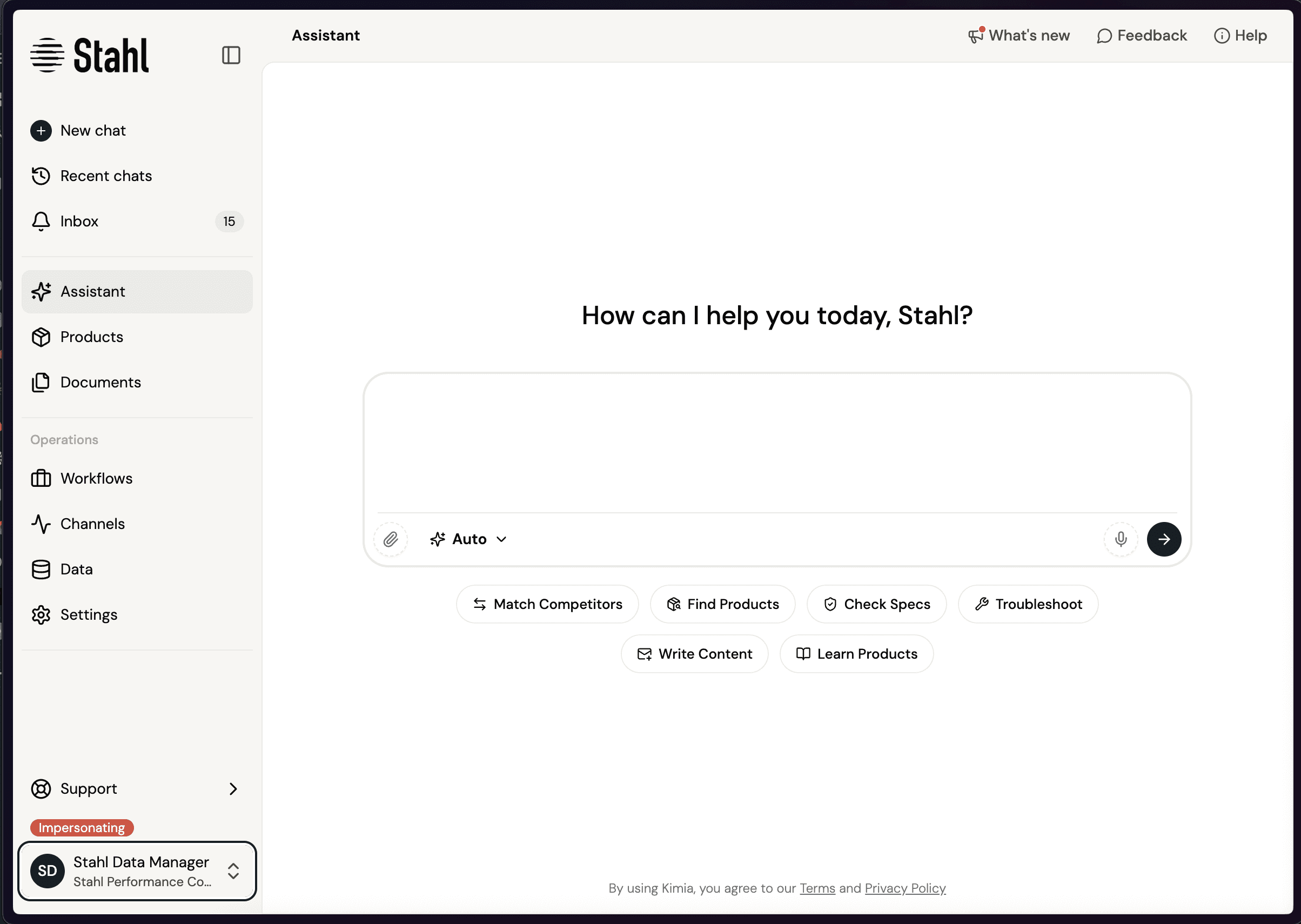
The knowledge also stopped being local. A salesperson in Brazil, a lab in China and a segment manager in the Netherlands draw on the same live information, in the language of the person asking, at any hour. One region can no longer be selling from a product range another region has moved on from, and the ask-a-colleague chain is gone.
The effect shows up sharpest in new hires. Getting a salesperson reliably useful in front of customers used to take months of training, and even then an experienced hire would sell without necessarily recommending the right product with the right information. A new salesperson can now be working in the field within about a week, without major mistakes. In coatings, where a wrong recommendation turns into a quality complaint or a compensation claim, the confidence is worth as much as the speed.
“Any salesperson right now, after a week or so, can go into the field and sell decently without making major mistakes.”
Uwe Siebgens
The laboratories work from the same source, so the phased-out-product problem ended. And the technical data sheet, the document a customer reads to know what a product is and how to use it safely, stopped being a bottleneck. Stahl keeps thousands of them accurate across shifting regulation and multiple languages, and producing one was cumbersome, expert-heavy work. It now takes a button-push, and the sheet comes out compliant with the current regulatory framework, in the customer’s language.
From one business unit to the whole company
More than 400 of Stahl’s 1,800 employees now use Kimia, over 300 of them in Performance Coatings where it began, and the number is still climbing.
The company noticed. Last year Stahl’s internal innovation award went to the team that built the data sheet generation, and Stahl has since created a dedicated AI innovation award. For a business that measures itself on know-how, that is recognition in its home currency.
The rollout is now moving from Performance Coatings to the entire company, as part of an AI roadmap Stahl is building for the whole organisation, on the simple logic that the more of the company’s data the system can reach, the more useful it becomes. New starters meet it on their first day.

Recruitment was never the point, and it changed anyway. Young technical talent now expects a serious employer to have something of this kind, and candidates arrive impressed that Stahl does.
The next step points outward: trusted, confidential data channels between Stahl and its customers, suppliers and startup partners, so that exchanges which currently wait for a scheduled call happen immediately, without the crown jewels ever leaving safe hands.
“I am always saying, if Stahl would know what Stahl knows, that would be wonderful. Kimia is the key to that.”
Paolo Bavaj, Chief Innovation and Corporate Development Officer

